Ted Krausman P.E.K-12 Buildings Iowa City Mechanical Group Leader
It sounds almost too good to be true: complete a qualifying project and receive a significant portion of the cost back.
But for private and public tax-exempt organizations like K–12 districts, that’s exactly what Inflation Reduction Act (IRA) tax credits are designed to do.
For districts facing aging HVAC systems and limited funding options, this incentive can significantly reduce the cost of critical facility upgrades.
The Inflation Reduction Act (IRA) introduced funding opportunities to support energy-efficient infrastructure. For tax-exempt entities like school districts, a direct pay provision allows school districts to receive funds directly from the federal government upon completion of construction.
For geothermal HVAC systems, districts may be eligible to receive federal incentives covering up to 50% of qualified project costs through a combination of tax credits, including a 30% geothermal rebate, an additional 10% for projects that use qualifying U.S.-made materials and components, and another 10% incentive for projects located in designated energy communities.
What Kind of Savings Are Possible?
“For qualifying geothermal projects, districts can recover around 30% of costs—with potential additional federal incentivesbringing that closer to 50%.”
— Ted Krausman, K-12 Buildings Iowa City Mechanical Group Leader, Shive-Hattery
Why This Matters for K–12 Schools
Districts can replace their out-of-date mechanical systems with a sustainable alternative at a significantly discounted rate. For districts facing aging infrastructure and limited funding options, this can be a game-changer.
“Like many districts, securing funding through bond referendums has been a challenge, so major facility upgrades always felt out of reach. The combination of SAVE funds and the IRA incentive changed that. It allowed us to move forward while being responsible stewards of our community’s resources—reducing disruption, improving our buildings, and leveraging every available dollar to make it happen.”
In this case, the district evaluated multiple HVAC options. Shive-Hattery provided a lifecycle cost analysis comparing the three mechanical systems and various building envelope improvements to help identify the best-fit solution. With this data, the district selected a geothermal system based on long-term maintenance preferences, quieter operation for neighboring homes, and improved energy efficiency. With IRA incentives, a project of this scale becomes far more financially feasible.
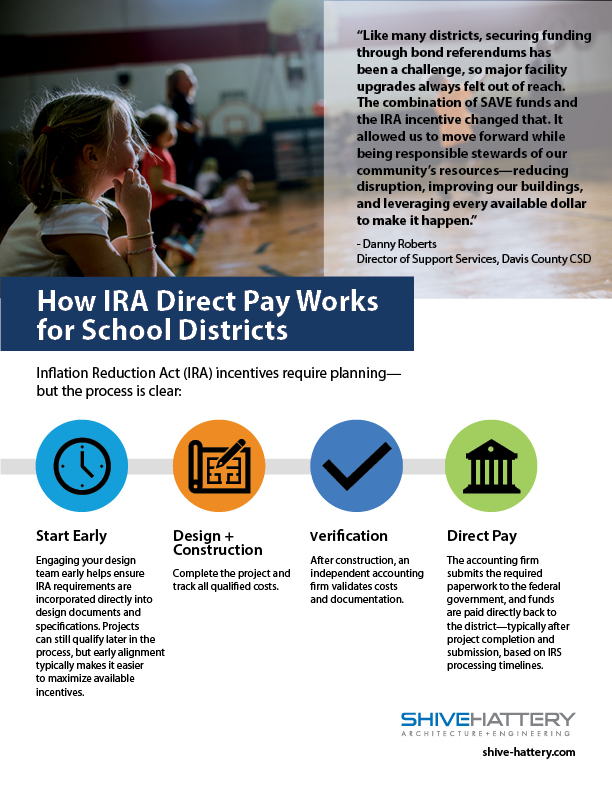
IRA incentives require planning—but the process is clear:
Start Early: Egaging your design team early helps ensure IRA requirements are incorporated directly into design documents and specifications. Projects can still qualify later in the process, but early alignment typically makes it easier to maximize available incentives.
Design & Construction: Complete the project and track all qualified costs.
Verification: After construction, an independent accounting firm validates costs and documentation.
Direct Pay: The accounting firm submits the required paperwork to the federal government, and funds are paid directly back to the district—typically after project completion and submission, based on IRS processing timelines.
“The direct pay provision is a significant shift for tax-exempt entities. From project planning through completion, we guide districts on eligibility, documentation, and compliance—helping them avoid common pitfalls—and ultimately prepare and file all required tax forms so they can receive funds directly from the federal government through a clear, structured process.”
— Austin Eden, Energy Credits & Incentives Manager, Eide Bailly
When Should Schools Act on IRA Tax Credits?
The sooner schools act, the greater the potential benefit, as tax credits begin phasing down in 2034. Projects see the greatest benefit when IRA requirements are incorporated from the start. While some completed projects may still qualify, doing so often requires additional effort.
While many projects benefit most from early planning, some recently completed projects may still qualify—though doing so can require additional documentation and coordination.
Timing also matters. Recent federal updates have introduced changing timelines and phase-downs for certain energy tax incentives, meaning benefit levels may decrease over time and eligibility requirements could continue to evolve:
Full tax credit values are currently available for projects that begin construction by end of year 2033.
Credit values phase down to:
75% of the available credit value for projects beginning construction in 2034
50% of the available credit value for projects beginning construction in 2035
No tax credits will be available for projects beginning construction in 2036 or later
While these incentives are not structured as a first-come, first-served program, funds are limited – districts that act sooner are better positioned to capture the full available benefit before policies shift.
A Smart Path Forward for K–12 Facility Funding
For districts navigating facility needs without passing bonds, IRA tax credits for schools offer a practical path forward—helping turn deferred maintenance into achievable, high-impact projects.
Considering a facility upgrade?
Now is the time to explore how IRA incentives could impact your project.